


Drawing Pencil Types Explained: Which Pencil Should You Use for Sketching?
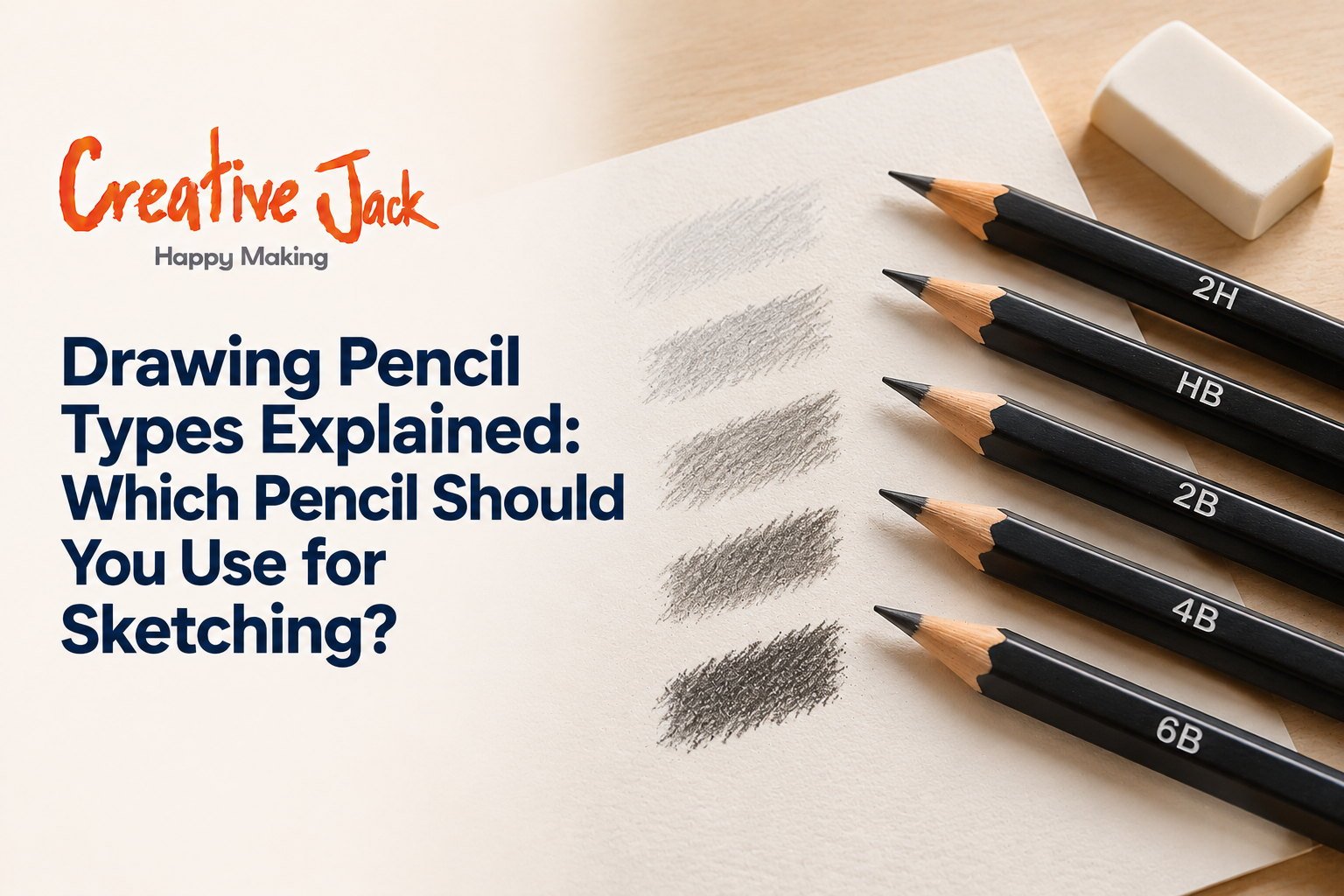
For sketching, most beginners need only three graphite pencils: an HB for light outlines, a 2B for general drawing, and a 4B for darker shading. The letters tell you how hard or soft the pencil is. H means hard and gives pale, crisp lines. B means soft and gives darker, smoother marks. HB sits in the middle. Add a 6B pencil later if you want deeper darks, and keep a mechanical pencil or a charcoal pencil as extras, not as starters.
What You'll Find in This Guide
• What the letters and numbers on a pencil actually mean
• The best pencil for sketching at each stage
• How graphite, charcoal, coloured, and mechanical pencils differ
• A simple starter kit that will not waste your money
• How to sharpen, hold, and look after your pencils
Why Pencil Choice Confuses So Many Beginners
Walk into a stationery shop and you will find pencils labelled 9H, 6H, 2H, H, F, HB, B, 2B, 4B, 6B, 8B, and sometimes up to 9B. There are also "art sets" of twelve or twenty-four pencils that look impressive and cost more than you need to spend.
New artists often make one of two mistakes. They buy one pencil, usually an HB, and try to do everything with it, which makes shading difficult. Or they buy a huge set and feel overwhelmed by choices they have no basis for making. The truth is that you can draw very well with three pencils. Pencils for drawing and pencils for sketching are largely the same thing at this stage, so you do not need two separate sets.
How the Pencil Grades Work
Pencil "lead" is not lead. It is a mix of graphite and clay. The more clay, the harder the pencil. The more graphite, the softer and darker it is.
H pencils (hard). More clay, less graphite. They make light, thin, precise lines and are hard to smudge. They are used for technical drawing, light construction lines, and fine details. They can dent the paper if you press hard.
HB (the middle). A balance of both. This is the everyday writing pencil, sometimes sold as No. 2. It is good for outlines and light sketching.
B pencils (soft or black). More graphite, less clay. They make darker, smoother lines and are good for shading. The higher the number, the softer and darker: 2B is a little soft, 4B is softer, 6B is very soft and dark.
F. Sits between H and HB. You will not need it as a beginner.
A rough guide:
Grade
Feel
Typical use
2H
Hard, pale
Faint guidelines
HB
Medium
Outlines, light sketching
2B
Slightly soft
General sketching and light shading
4B
Soft, dark
Shading, darker areas
6B
Very soft, very dark
Deep shadows, expressive work
The Best Pencil for Sketching: A Beginner Kit
If you are starting out, buy these three.
HB. For your first light lines. Because it is not too dark, you can erase it easily.
2B. This will probably become your favourite. It is smooth enough for shading and firm enough for lines.
4B. For darker shadows and richer tones.
That is your core set. If you want to go further, add a 6B for very dark areas and a 2H for very light guidelines. You do not need more than five pencils until you know exactly what is missing.
Other Types of Pencil You Will Come Across
Charcoal Pencils
Charcoal pencils are made of compressed charcoal in a wooden casing. They produce rich, velvety blacks that graphite cannot match. They are great for dramatic tone and portraits, but they smudge easily and are harder to erase. If you want to try charcoal, start after you are comfortable with graphite. The principles of tone are the same. In our Professional Art Course, charcoal is taught for portraits, landscapes, still life, and nature drawings, with a focus on tonal values and light and shadow.
Coloured Pencils
These are for colour work and need a different approach, with layering and blending of pigment rather than shading graphite. Learn graphite first, because the drawing skills carry across.
Mechanical Pencils
A mechanical pencil keeps a consistent point without sharpening, which is handy for fine detail and technical work. Leads come in sizes like 0.3, 0.5, and 0.7 mm. They are less good for broad shading because the lead is thin and hard to use on its side.
Water-Soluble Graphite and Graphite Sticks
These let you create washes or broad tone. They are fun to experiment with, though not necessary at the beginning.
Paper Matters as Much as the Pencil
A great pencil on poor paper gives poor results.
Smooth paper gives fine lines and detail but takes less graphite, so deep shading is harder.
Slightly textured paper grabs graphite well and is better for shading and tone.
Weight. A sketchbook with paper around 120 to 150 GSM is a good place to start. Thin paper tears with heavy erasing.
If you find you cannot get dark tones, the cause may be the paper, not your pencil.
How to Hold and Sharpen Your Pencil
For detail, hold the pencil like a pen, close to the tip. For loose sketching and shading, hold it further back, with the pencil resting lightly across your fingers. You can even use the side of the lead for broad tone.
Sharpening. A basic sharpener works, but a craft knife gives you a longer point and more control. Keep your HB sharp for outlines. Let your B pencils get a little rounder for shading. A blunt pencil is often better for broad tone.
Erasers. A kneaded eraser can be shaped and lifts graphite gently without damaging paper. A plastic eraser removes marks cleanly. A small precision eraser helps with highlights.
Common Pencil Mistakes
Pressing hard with a soft pencil. It smears and makes shading muddy. Let the pencil do the work.
Using H pencils too heavily. They can leave grooves in the paper that are hard to hide.
Trying to get dark tones with an HB. Layering and pressing hard can only take you so far. A 4B gives a darker tone with less effort.
Smudging with fingers. Oil from your skin can leave marks. Use a blending stump or a tissue, and rest your hand on a scrap sheet.
Once you are comfortable with your pencils, learning to shade is the next step. Our post on seven shading techniques shows you how to use them.
See It in Use
It is much easier to understand pencil grades when you watch someone use them. You can find demonstrations on the Creative Jack YouTube channel, and see finished pencil work on our Instagram.
How Creative Jack Approaches Materials
In a studio class, you often get to try different pencils before you buy a whole set. Creative Jack's Pencil Drawing category covers realism portrait pencil drawing, and the Professional Art Course introduces charcoal alongside painting mediums. Ask your teacher which pencils they recommend for your level, and buy those, rather than guessing.
FAQs
Which pencil is best for sketching? A 2B is a good all-rounder for sketching. An HB is good for light outlines, and a 4B for darker shading.
What is the difference between HB and 2B? HB is harder and lighter. A 2B is slightly softer and darker, and shades more easily.
Do I need a full set of pencils? No. Three pencils (HB, 2B, 4B) are enough to begin.
Is a mechanical pencil good for drawing? It is good for fine detail and clean lines, but not ideal for broad shading.
Should I use charcoal pencils as a beginner? It is better to learn tone with graphite first. Charcoal is more expressive but harder to control.
Why do my pencil drawings look pale? You may be using a pencil that is too hard, or paper that is too smooth. Try a 2B or 4B and paper with a bit of texture.
Can I use a normal writing pencil for drawing? An HB writing pencil works for light sketching, but you will want softer pencils for shading.
Buying Pencils in Mumbai and Pune
If you are in Mumbai, Navi Mumbai, Thane, or Pune, most stationery and art supply shops stock graphite pencils in single grades. Buy individual pencils rather than a large set. If you attend a class, ask your teacher where they buy their materials.
Want Help Choosing Materials?
Come and try a class before you buy anything. Book a free trial class or message us on WhatsApp.
Related reads: Complete Beginner's Guide to Drawing | 7 Shading Techniques Every Beginner Artist Should Learn | How to Start Drawing as a Beginner