


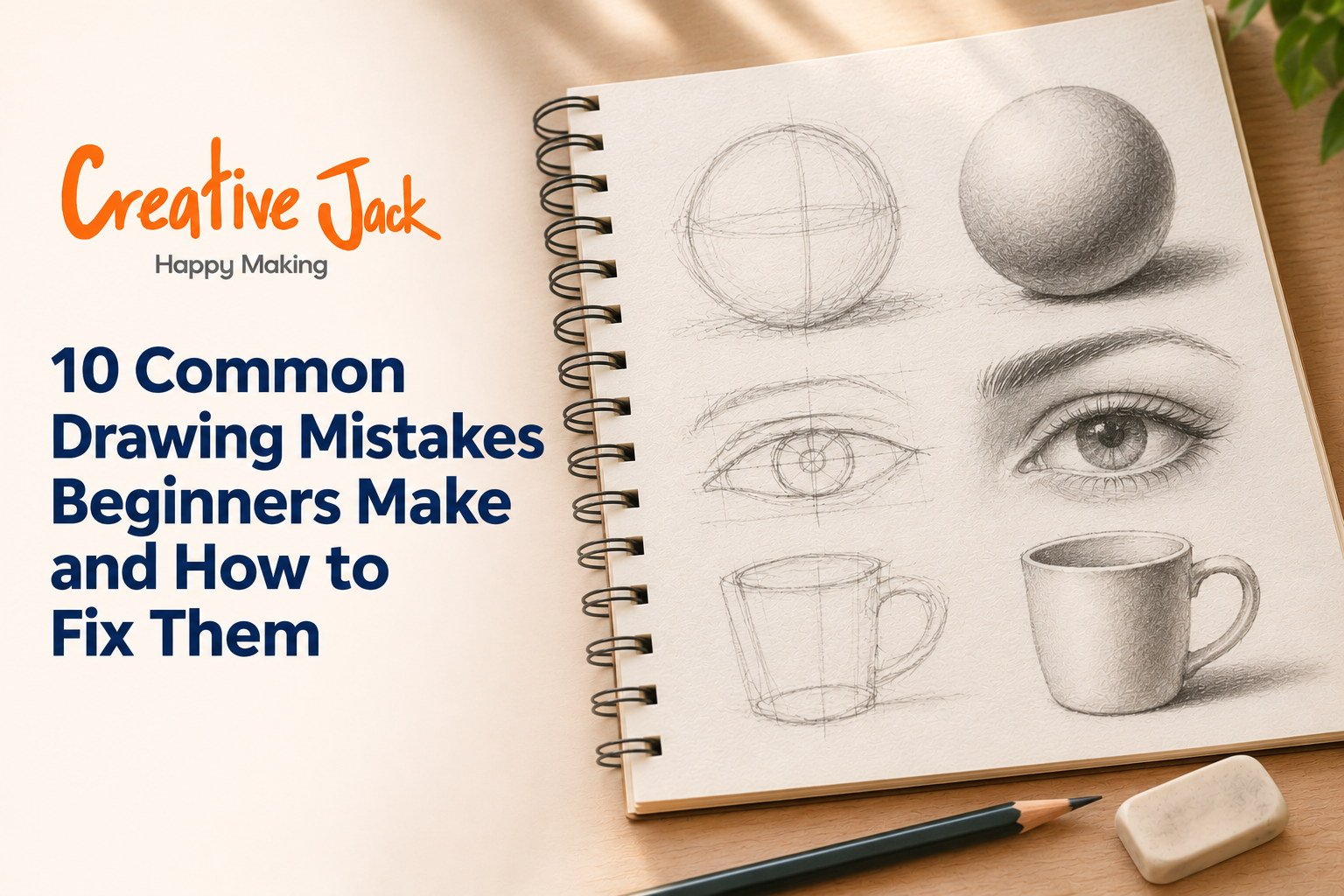
10 Common Drawing Mistakes Beginners Make and How to Fix Them
The most common drawing mistakes beginners make are gripping the pencil too tightly, pressing hard too early, skipping basic shapes, drawing symbols instead of what they see, getting proportions wrong, ignoring tone, adding detail too soon, erasing too much, practising without a plan, and learning without feedback. Every one of these is fixable, and most can be fixed in a week or two once you know what to look for.
What You'll Find in This Guide
• Ten specific mistakes, with a clear fix for each
• How to tell which one is holding your drawings back
• Quick exercises you can do straight away
• When it helps to get outside feedback
Why Mistakes Are Useful
If you feel discouraged by your drawings, try thinking of each problem as information. A flat drawing tells you that tone needs work. A lopsided face tells you your measuring needs work. Mistakes are the clearest map of what to practise next. Treat the beginner drawing mistakes below as drawing tips for beginners in disguise: each one tells you what to do differently.
Most of these are not talent problems. They are habit problems, and habits can be changed. Here they are, roughly in the order that they tend to show up.
1. Gripping the Pencil Too Tightly
What it looks like: Shaky, scratchy lines. A tired hand after ten minutes.
Why it happens: Beginners tend to hold a pencil like they are writing an exam, with all the tension in the fingers.
The fix: Loosen your grip. For sketching, hold the pencil further back, and move from your elbow and shoulder as well as your wrist. Draw long, light lines across a page for a few minutes as a warm-up. If your hand hurts, you are holding too hard.
2. Pressing Hard Too Early
What it looks like: Dark, deep lines you cannot erase. Grooves in the paper. Smudged, muddy shading.
Why it happens: We want to commit to our lines and avoid looking tentative.
The fix: Start light. Think of the first layer as a suggestion, not a statement. Build gradually, and save heavy pressure for the final darks. A soft pencil like a 2B or 4B does more with less pressure. Our guide to drawing pencil types explains why.
3. Skipping Basic Shapes
What it looks like: Objects that feel wobbly, or that do not seem to have any structure.
Why it happens: Basic shapes feel boring, and it is tempting to leap to the interesting subject.
The fix: Before drawing anything, ask what simple form it is closest to. A bottle is a cylinder. A head is a sphere with a jaw. Lightly sketch that form first, then refine. Spend a few minutes each session drawing cubes, spheres, and cylinders.
4. Drawing What You Think You See
What it looks like: Stylised, symbol-like drawings: a sideways almond for an eye, a hooked line for a nose, a star-shaped flower.
Why it happens: Our brains simplify. They store a symbol for "eye" and bring it out instead of letting us look.
The fix: Slow down and look. Draw the actual shapes you see, including the gaps and the angles. Try drawing something upside down, or draw the shapes between objects, called negative space. Both force you to see instead of assume.
5. Getting Proportions Wrong
What it looks like: A head that is too small for the body, a cup that is too tall, a face with the features placed too high.
Why it happens: Drawing proportions is a measuring job, and beginners rarely measure. They draw by feel, and feelings are unreliable.
The fix: Measure. Hold a pencil at arm's length, close one eye, and compare the height of one part of your subject to another. Is the cup twice as tall as it is wide? Check it on your drawing. For faces, use the eye-line and thirds guidelines in our guide to drawing realistic portraits.
6. Ignoring Light and Shadow
What it looks like: A flat, cartoonish drawing, even when the outline is accurate. If you have ever asked why does my drawing look flat, this is usually the answer.
Why it happens: Outlines are easy and tone takes patience.
The fix: Decide where the light comes from before you start. Mark the brightest area, the mid-tone, and the darkest shadow. Practise a value scale and a shaded sphere, then apply it to objects. Our post on seven shading techniques will get you started.
7. Adding Detail Too Soon
What it looks like: One beautifully detailed eye on a face that does not fit together.
Why it happens: Details are fun and give quick rewards.
The fix: Work from big to small. Block in the largest shapes first, then the mid-sized shapes, then the details last. If the large structure is wrong, no amount of detail will fix it. A good rule is to leave details until you are happy with the overall shape and proportion.
8. Erasing Too Much
What it looks like: Thin, scuffed paper. Ghost lines everywhere. Frustration.
Why it happens: We are afraid of leaving a wrong line on the page.
The fix: Draw lightly so that errors are easy to correct, and don't erase every line. Many artists leave visible construction lines, which adds life to a sketch. If a line is wrong, draw the correct one beside it and keep going. You can clean up at the end.
9. Practising Without a Plan
What it looks like: Lots of drawing, little improvement.
Why it happens: Random practice repeats what you already do.
The fix: Pick one skill for the week, such as proportion, shading, or line control. Do short, focused exercises on it. Keep a log, even a simple one. Our list of 10 drawing exercises gives you a place to start.
10. Learning Without Feedback
What it looks like: Months of practice with the same errors, repeated again and again.
Why it happens: It is very hard to see your own mistakes. You get used to your own drawing, and your brain corrects for what is wrong.
The fix: Show your work to someone who knows what to look for. That might be a teacher, a friend who draws, or an online community. A teacher can spot in seconds what you cannot see in months. This is the main reason people join a class. If you are looking at drawing classes for adults near me, check that there is real time for individual feedback, not just a demonstration. And if you are comparing the best drawing courses on offer, ask how many students are in each batch and how often the teacher looks at your work.
Which Mistake Is Yours?
A quick way to find out: lay out your last five drawings and ask these questions.
• Do the lines look shaky or too heavy? (Mistakes 1 and 2)
• Do the objects look wobbly? (Mistake 3)
• Do they look stylised or symbolic? (Mistake 4)
• Do the proportions look off? (Mistake 5)
• Do they look flat? (Mistake 6)
• Are some parts overworked and others unfinished? (Mistake 7)
• Is the paper worn from erasing? (Mistake 8)
Fix one or two at a time. Trying to fix everything at once usually makes things worse.
See Fixes in Action
Seeing a mistake corrected is often easier than reading about it. Watch short demonstrations on the Creative Jack YouTube channel, and see student progress on our Instagram.
How Creative Jack Helps With Feedback
Creative Jack courses are taught by certified instructors who give personal guidance, and our beginner-level courses are designed for complete freshers. The Professional Art Course includes anatomy sketching, charcoal, and light and shadow, and we offer a Pencil Drawing course focused on realism portraits. Classes are available online and offline depending on the batch.
FAQs
What is the most common drawing mistake for beginners? Drawing symbols instead of what you actually see, and skipping basic shapes and proportion checks.
How do I stop my drawings from looking flat? Add tone. Decide on a light source and build a range from light to dark, with a cast shadow underneath.
Should I use an eraser a lot? Use it sparingly. Draw lightly and leave some construction lines visible.
Why are my proportions always wrong? You may be drawing by feel. Measure by comparing sizes with a pencil held at arm's length.
How can I tell if I need a teacher? If you practise regularly and your drawings are not improving, or you keep repeating the same errors, feedback will help.
Is it normal for my drawings to look bad at first? Yes. Your eye develops faster than your hand, which is why early drawings feel disappointing.
How long does it take to fix these habits? Many can be improved within a few weeks of focused practice.
Getting Feedback in Mumbai, Navi Mumbai, Thane, and Pune
If you would like in-person feedback, our Professional Art Course is listed at Art Station Andheri West, Khar West, CBD Belapur, and FC Road Pune, and at Mango Stationery in Thane West. See pencil drawing classes in Mumbai for what to check before you join.
Want Someone to Look at Your Drawings?
Book a free trial class or message us on WhatsApp.
Related reads: Complete Beginner's Guide to Drawing | How to Start Drawing as a Beginner | How to Improve Your Sketching Skills: 10 Drawing Exercises