


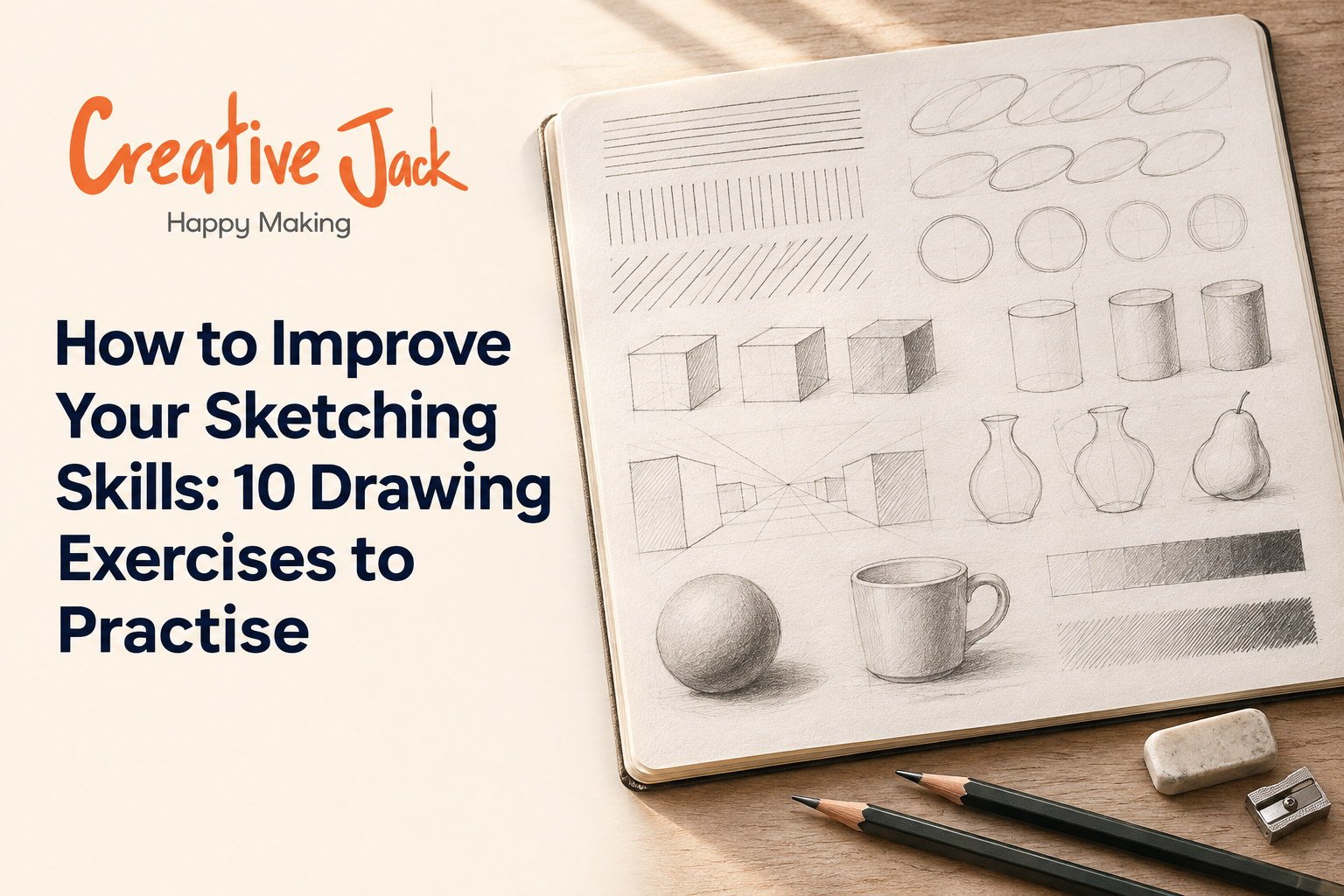
How to Improve Your Sketching Skills: 10 Drawing Exercises to Practise
To improve your sketching skills, practise ten short exercises: straight lines, circles and ellipses, a value scale, contour drawing, blind contour drawing, gesture drawing, basic forms with shading, still life from life, negative space drawing, and a short daily sketch. Each takes between 5 and 30 minutes and trains one specific skill. Do two or three a session, and rotate through all ten across the week.
What You'll Find in This Guide
• Ten exercises, each with what it trains and how to do it
• How long each takes and what you need
• A weekly schedule that rotates them
• How to tell whether you are improving
• When feedback from a class makes the biggest difference
Why Exercises Beat "Just Drawing More"
Drawing more is good. Drawing more of the same thing is slow. If you always sketch the same kind of subject, in the same way, you reinforce what you already do, including your errors.
Exercises break drawing into small skills: control, observation, proportion, tone. You practise one at a time, so improvement is faster and easier to see. Think of it the way a musician practises scales before playing a song. It is not glamorous, but it works.
If you want to know how to improve sketching skills and improve drawing skills at the same time, these sketching exercises are the quickest form of sketching practice we know. You only need a sketchbook, a pencil or two, and a timer.
Exercise 1: Straight Lines and Ghosting
Trains: Line control and confidence. Time: 5 minutes.
Pick two points on the page. Move your pencil above the paper between them a few times without touching, which is called ghosting. Then draw the line in one quick motion. Repeat with lines in different directions, parallel lines, and lines that fan out from a point.
What to watch for: Lines drawn in one confident stroke look cleaner than lines made of tiny, hesitant scratches. Don't worry if they are not perfectly straight.
Exercise 2: Circles and Ellipses
Trains: Control of curves, which you need for almost every object. Time: 5 to 10 minutes.
Fill a page with circles, then ellipses of different widths. Try to draw each in a single flowing motion. Draw them at different sizes and angles. Do some with your whole arm moving from the shoulder.
What to watch for: Closing the shape cleanly. Gaps and overlaps show you where control needs work.
Exercise 3: The Value Scale
Trains: Tone, pressure control, and an understanding of light. Time: 10 minutes.
Draw a strip of five to nine squares. Shade the first as lightly as possible and the last as darkly as possible. Fill the squares between so that each step is a little darker than the last. Aim for even steps.
What to watch for: If two neighbouring squares look the same, or one jumps too much, redo it. Our post on seven shading techniques gives you ways to build tone.
Exercise 4: Contour Drawing
Trains: Observation and hand-eye coordination. Time: 10 to 15 minutes.
Choose an object, such as a shoe or a hand. Draw its outline slowly, following the edge with your eye while your pencil moves at the same pace. Include the internal edges, like folds and creases.
What to watch for: Looking at the object more than at your paper. The aim is to draw what is there.
Exercise 5: Blind Contour Drawing
Trains: Pure observation, plus freedom from perfectionism. Time: 5 to 10 minutes.
Do the same as above, but do not look at your paper at all. Keep your pencil on the page and your eyes on the subject. The result will look odd, and that is the point. You will notice your drawing hand begins to follow your eye more closely.
What to watch for: The proportion and flow of the drawing, rather than neatness. Blind contour is a good warm-up before serious work.
Exercise 6: Gesture Drawing
Trains: Speed, movement, and capturing the essence of a subject. Time: 5 to 10 minutes, with 30 to 60 second poses.
Draw a person, pet, or moving subject very quickly in 30 to 60 seconds, using loose, flowing lines to capture the pose. Use a photo reference or draw from life. Do ten of them in a row.
What to watch for: The main line of action. Don't draw details. Aim for energy.
Exercise 7: Basic Forms With Shading
Trains: Turning flat shapes into three-dimensional forms. Time: 15 minutes.
Draw a cube, a sphere, a cylinder, and a cone. Place a light source to one side. Shade each one with highlights, mid-tones, core shadows, and cast shadows.
What to watch for: Whether each form looks solid. If it looks flat, the tone range may be too narrow. Most complex objects are combinations of these forms, so this exercise pays off in everything else.
Exercise 8: Still Life From Life
Trains: Proportion, composition, and tone together. Time: 20 to 30 minutes.
Set up two or three simple objects near a window or lamp. Draw them, starting with the big shapes, then proportion, then shading. Measure by holding a pencil at arm's length.
What to watch for: The relationships between objects: size, spacing, and overlap. Try to draw the objects in relation to each other rather than separately.
Exercise 9: Negative Space Drawing
Trains: Seeing shapes instead of symbols. Time: 10 to 15 minutes.
Choose an object with gaps, such as a chair or a plant. Instead of drawing the object, draw the empty spaces around and between its parts. Shade the negative shapes. When you finish, the object appears.
What to watch for: How much easier it is to be accurate when you are not thinking "chair". The shapes between parts are simple and unfamiliar, so your brain cannot use symbols.
Exercise 10: The Daily Five-Minute Sketch
Trains: Habit, speed, and a visual memory of the world. Time: 5 minutes.
Every day, sketch one thing in front of you for five minutes. A cup of tea, your shoes, the view outside the window. Do not edit. Date the page.
What to watch for: After a month, flip back through the pages. This is where you see the real change. It is also the best way to build a long-term habit.
A Weekly Rotation
You do not need to do everything every day. Here is one way to spread the ten exercises across a week.
• Monday: Exercises 1, 2, and 3 (control and tone)
• Tuesday: Exercises 4 and 5 (observation)
• Wednesday: Exercise 7 (forms and shading)
• Thursday: Exercises 6 and 9 (gesture and negative space)
• Friday: Exercise 8 (still life)
• Daily: Exercise 10
How to Know You Are Improving
Keep your work. Every four weeks, pull out one drawing from each exercise and compare. Look for steadier lines, more accurate proportions, and a wider range of tones. Improvement is slow day to day and obvious month to month.
If you are not seeing change after six to eight weeks of regular work, it may be time to get feedback. Our guide to common drawing mistakes can help you diagnose the problem, and a teacher can confirm it.
Why Feedback Helps
These exercises work on their own, but a teacher turns them from exercises into a plan. In a class, someone watches your hand during the exercises and tells you straight away that your grip is too tight or that your circles drift. If you are looking for sketching classes, ask whether the teacher gives individual feedback during practice, not just at the end. That is what separates a useful class from a long demonstration. Some people also like sketching classes for beginners because the group practises the same exercises together, which helps with motivation. And for working adults, sketching classes for adults often run in the evening or on weekends, so you can fit them around a job.
See the Exercises Done
Watch demonstrations on the Creative Jack YouTube channel, and browse sketchbook pages on our Instagram.
How Creative Jack Uses Exercises in Class
Our beginner-level Professional Art Course starts with anatomy sketching and builds towards tonal values, light and shadow, and composition, so a lot of these exercises feed directly into it. You can also look at the Pencil Drawing category for our realism portrait course. Our beginner courses are designed for complete freshers.
FAQs
What is the best exercise to improve sketching? Contour drawing and still life from life are among the most effective, because they train observation.
How long should I practise each day? Twenty to thirty minutes is enough for most people, as long as you are regular.
What is gesture drawing? It is quick drawing, usually 30 to 60 seconds, that captures the movement and flow of a pose rather than the details.
Why does blind contour drawing help? It forces you to look at your subject, not your paper, which trains your hand to follow your eye.
Can I do these exercises with a pen? Yes. Pens force you to commit to lines, which is helpful, but start with pencil if you are nervous.
How many exercises should I do in one session? Two or three. More than that and you start to rush.
Do I need a teacher to do these? No, but a teacher helps you correct errors early.
Practising in Mumbai, Navi Mumbai, Thane, and Pune
If you would like to practise in a studio, our Professional Art Course is listed at Art Station Andheri West, Khar West, CBD Belapur, and FC Road Pune, and at Mango Stationery in Thane West. Check the course page for batches.
Want a Teacher to Guide Your Practice?
Book a free trial class or message us on WhatsApp.
Related reads: How to Start Drawing as a Beginner | 10 Common Drawing Mistakes Beginners Make | How Long Does It Take to Learn Drawing and Sketching?