



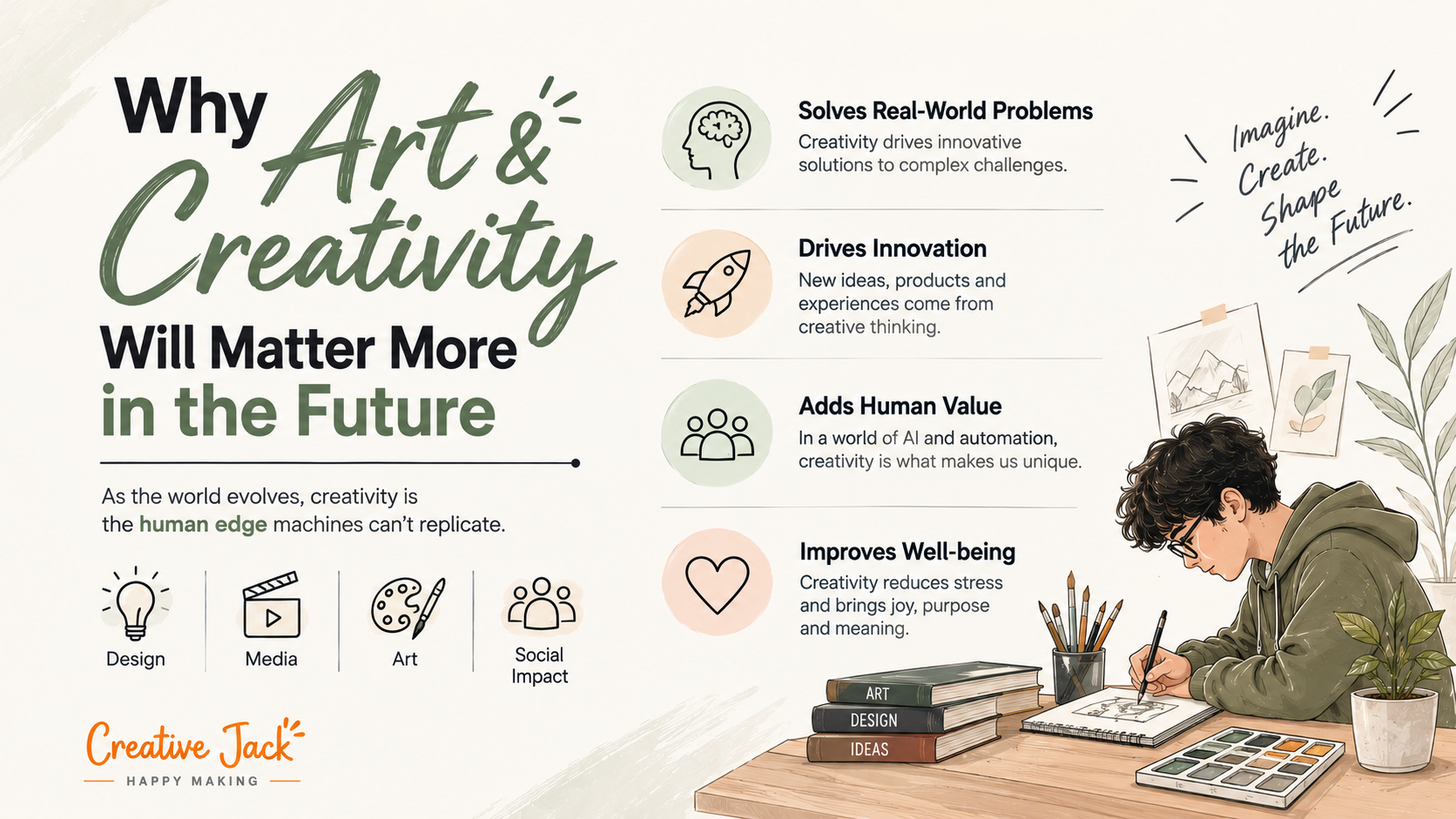
Why Art and Creativity Will Matter More in the Future
Art and creativity will matter more in the future because as automation and AI handle repetitive tasks, human-driven creative thinking, original visual expression, and design sensibility become increasingly valuable differentiators across nearly every industry, not just traditional creative fields.
In This Guide, You’ll Learn:
• Why creativity is becoming more valuable, not less, in an automated world
• Which industries are increasingly relying on creative skills
• How art training builds transferable thinking skills
• What this shift means for students choosing a creative path
Why People Underestimate the Future Value of Creativity
Creativity is often dismissed as a “soft skill” compared to technical fields, largely because of:
• Assuming automation and AI will replace the need for human creative input
• Viewing creativity narrowly as just drawing or painting, rather than a broader thinking skill
• Not recognizing how many non-creative industries now actively seek creative problem-solvers
• Underestimating how originality and taste remain distinctly human strengths
Step 1: Understand Why Repetitive Tasks Are Being Automated, Not Creative Ones
As automation handles routine, repeatable tasks, the tasks that remain distinctly valuable are the ones requiring original thinking, taste, and human judgment, core strengths built through creative and art training.
Step 2: See How Creativity Extends Beyond Traditional Art Fields
Industries like tech, marketing, product development, and even finance increasingly value employees who can think creatively, solve problems in novel ways, and communicate visually.
Step 3: Recognize Design Thinking as a Transferable Skill
Design thinking, a structured approach to creative problem-solving, is now taught in business schools and used across product development, innovation strategy, and entrepreneurship, not just design studios.
Step 4: Understand How Art Training Builds This Thinking
Structured art education doesn’t just teach technical skills like drawing, it builds observation, composition, and problem-solving habits that transfer directly into design thinking and creative strategy roles.
Step 5: Prepare for a Future That Values Human Creative Judgment
As AI tools become more common in creative workflows, the ability to direct, curate, and add original human judgment to creative output becomes an increasingly valuable and defensible skill.
Visual Proof: Creative Thinking in Action
Strong creative training builds visible skill in observation, composition, and original problem-solving, the exact qualities that remain distinctly valuable as automation grows. See real examples of student creative work on the Creative Jack Instagram.
How Creative Jack Builds Lasting Creative Thinking Skills
At Creative Jack, students develop strong fundamentals in design thinking, drawing skills, visualization, and problem-solving, skills built to remain valuable regardless of how technology reshapes specific creative tools and workflows.
FAQs
Will AI reduce the need for creative skills in the future? Most evidence suggests AI is becoming a tool within creative workflows rather than a replacement for human-directed creativity, taste, and judgment.
Why is creativity considered valuable outside traditional art fields? Many industries now value creative problem-solving, design thinking, and original visual communication as core professional skills, not just artistic ones.
What is design thinking, and why does it matter? Design thinking is a structured, creative approach to problem-solving that’s increasingly used in business, technology, and innovation strategy beyond traditional design fields.
Does art training build skills useful outside art careers? Yes. Observation, composition, and creative problem-solving skills built through art training transfer well into many non-art professional contexts.
Is creativity a skill that can be trained, or is it innate? Creativity is largely a trainable skill, built through structured practice, exposure, and guided feedback, similar to any other learnable skill.
How can students future-proof their creative careers? Building strong foundational creative thinking skills, alongside comfort with digital tools, offers the most adaptable path as industries continue to evolve.
Building Creative Thinking Skills in Mumbai and Pune
If you’re based in Mumbai, Pune, or Belapur, structured art and design training locally can help build the kind of creative thinking skills increasingly valued across both traditional and non-traditional career paths.
Want to Learn Art the Right Way?
If you believe creativity will matter more in the years ahead, building strong creative thinking skills now is a genuinely future-proof investment. Creative Jack’s structured courses build exactly this kind of foundational, transferable skill set.
Talk to us or explore our other Courses to get started.
Related reads: What Is the Scope of Art in the Future? A Complete Career Guide | Is Art a Good Career in the Future? Opportunities for Students | 10+ Career Options for Art Students in the Future